
Could Excess Fertiliser Be Affecting Your Kiwifruit Orchard?
Many kiwifruit orchards are applying fertiliser even when soil nutrient levels are already above the optimal range. In some cases this means hundreds of kilograms of unnecessary fertiliser per hectare — costing money while potentially reducing vine health and fruit quality.
Stressed vines are more vulnerable to vine decline, reduced yields, poor fruit quality, and in the worst cases, complete collapse.
More fertiliser is not always the answer.
Case Study
Example: When Soil Potassium Is Already High
One orchard soil test showed potassium levels of 1.82 mg/L, while the recommended range was 0.6–1.2 mg/L.
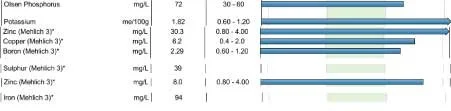
Despite this, the fertiliser recommendation included:
250 kg/ha potassium sulphate
100 kg/ha SOP
Applying this fertiliser would push potassium levels even higher. Excess potassium can reduce magnesium uptake, potentially leading to vine health issues later in the season.
Question growers should ask:
If soil levels are already above the target range, do we need to apply more potassium this year?
The grower was recommended a total of 11 products including:
an additional 273kg/ha of potassium (already off the chart)
more zinc (already off the chart) in the form of 35kg/ha of zinc sulphate
Brimstone (sulphur). Possibly due to this label claim: “Deficiency is commonly seen as yellowing of plants due to its role along with nitrogen in protein synthesis.”. This suggests premature yellowing of leaves is being blamed on a sulphur deficiency.
Megafol which contains boron (already in the high (toxic) column)
Brexil Fe despite no evidence of an Fe deficiency
The recommendations do not seem to be based on the desired/required levels.
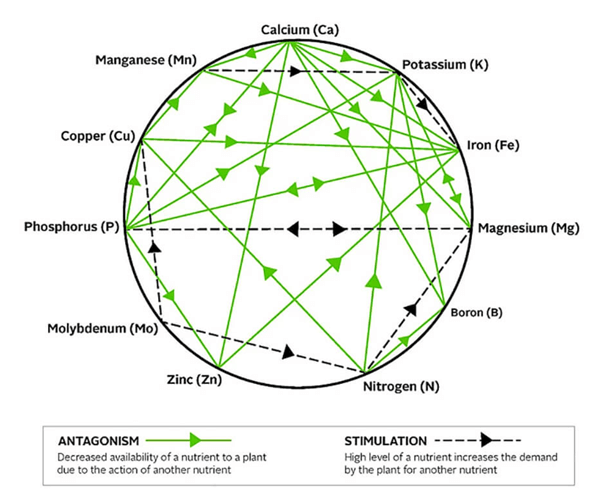
At these levels the plant is under stress (see Mulder’s Chart below) and the crop suffers.
Questions growers should ask:
Do the recommendations align with medium or desired levels?
What is the cost of applying this programme vs the benefit/harm to my vine health and fruit quality?
More examples of soil test results from kiwifruit orchards - note how common it is for nutrients to be high (toxic) and even off the chart.
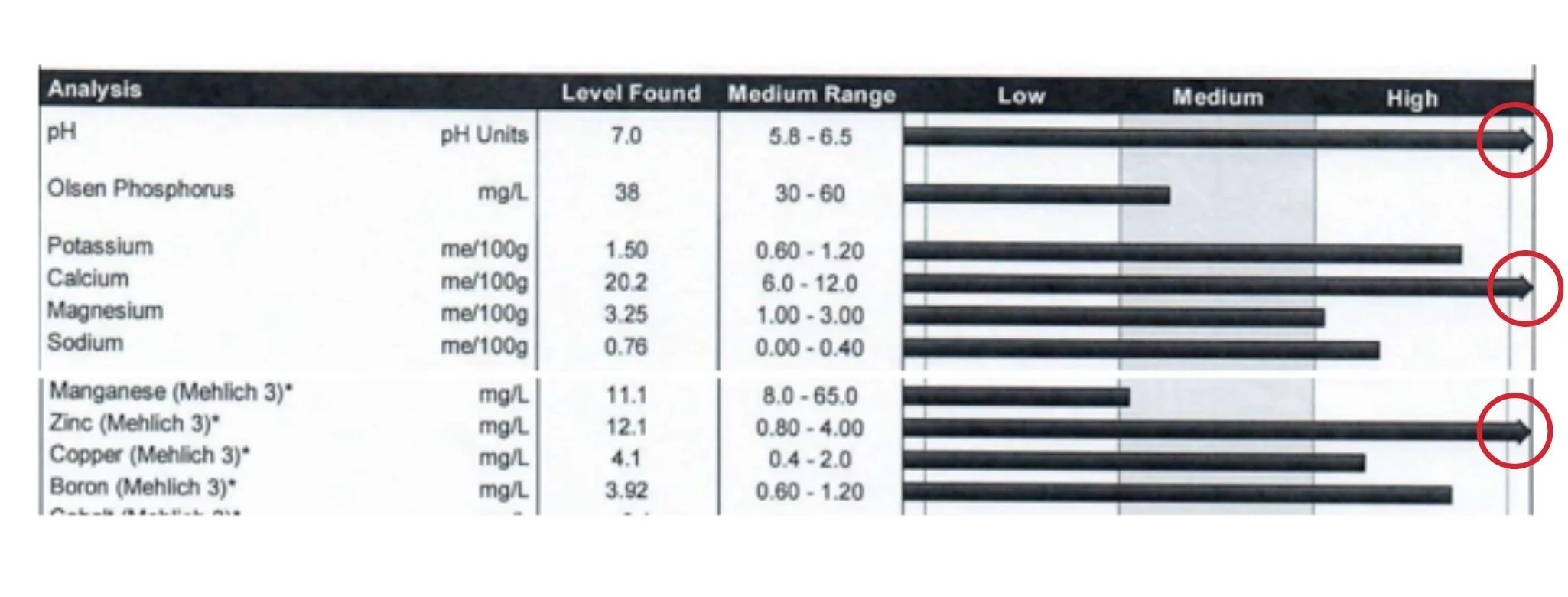
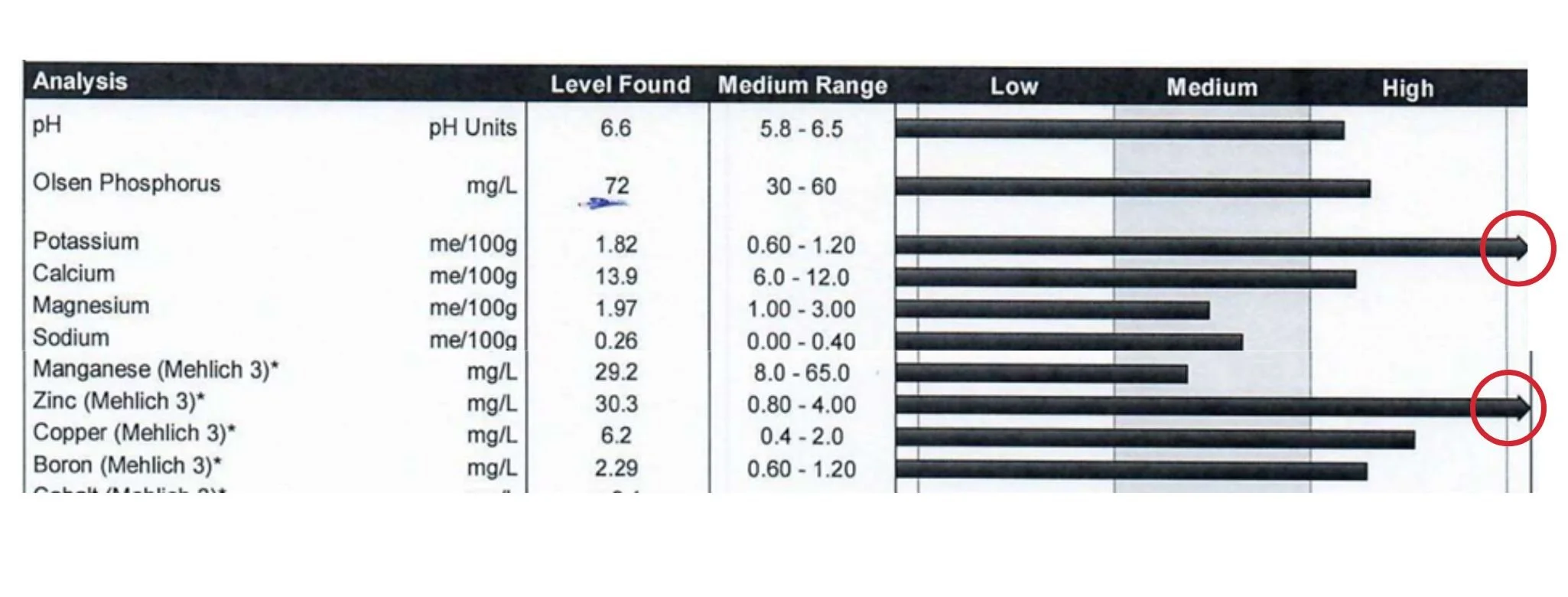
Growers are sometimes encouraged to chase “high fertility” targets, but plants under stress from high nutrients struggle to take up other elements they need.
Mulder’s Chart shows how excess soil nutrients lock up (cause a deficiency in) other nutrients.
e.g.
Excess Potassium locks up Magnesium and Calcium.
Excess Nitrogen locks up Calcium, Magnesium and Potassium.
Why does over-fertilisation cause problems?
How does excess fertiliser affect vine health and fruit quality?
Copper is a special concern because:
Copper is highly toxic to plants,
PSA is resistant to Copper,
Copper has not controlled PSA disease manifestation: https://kvh.org.nz/assets/projects/103415_2021-10-26-224949_rclw.pdf (see pg9)
Other nutrients of particular concern are Boron, Potassium and Nitrogen
Boron:
High levels of boron can result in premature softening of fruit: https://www.sciencedirect.com/science/article/abs/pii/0304423889900241#:~:text=Excess%20boron%20was%20associated%20with,on%20mean%20weight%20fruit%E2%88%921.
Potassium and Nitrogen:
High rates of potassium and nitrogen may increase kiwifruit yield but can also decrease flesh firmness:
https://www.researchgate.net/publication/237344260_Influence_of_nitrogen_and_potassium_on_yield_fruit_quality_and_mineral_composition_of_kiwifruit
& https://www.sciencedirect.com/science/article/pii/S2095311917618999Excessive potassium locks up magnesium in the soil resulting in magnesium deficiency and potassium induced leaf breakdown syndrome: https://www.zestbiotech.co.nz/leaf-breakdown
Fertiliser Balance
Unbalanced fertiliser treatments and excessive fertiliser can harm yield and quality:
https://www.sciencedirect.com/science/article/pii/S2351989419309746
What can you do to manage this problem?
1. Immediately:
Stop using copper after bud burst. Apply humates to lock up copper in the soil.
Apply fertilisers only if test results indicate that there is a deficiency – do not aim for “high fertility” (toxic levels).
Foliar application of nitrogen should be stopped unless you have evidence of need/benefit.
Overcome leaf breakdown in the short-term by applying magnesium sulphate. Stop using potassium until soil levels drop into the desired range.
Check the contents of foliar feeds - some (particularly imported products) may contain high levels of micro and macro nutrients.
Bear in mind that nutrients interact - by applying too much of one nutrient other nutrients may become less available, causing a deficiency. See Mulder's Chart.
Use the Agrizest/Primazest programme. In orchards with high soil potassium levels, combine magnesium sulphate with the Agrizest/Primazest programme. This will improve fruit quality and reduce stress from salinity, the severity of leaf breakdown and premature leaf fall.
Agrizest and Primazest reduce abiotic and biotic stress and allow vines to be healthier and more productive.
2. In the long term:
Industry fertiliser standard levels may need to be investigated and adjusted to suit current varieties, industry practices and soil health.
If you are unsure please seek independent advice.
Fertiliser Checklist
What are my current soil nutrient levels?
What is the recommended range for my orchard?
Will this fertiliser keep levels in the middle/desired range?
Could excess nutrients cause an imbalance that harms my bottom line?
What can I do to manage stress in my orchard to lift vine health and fruit quality?